
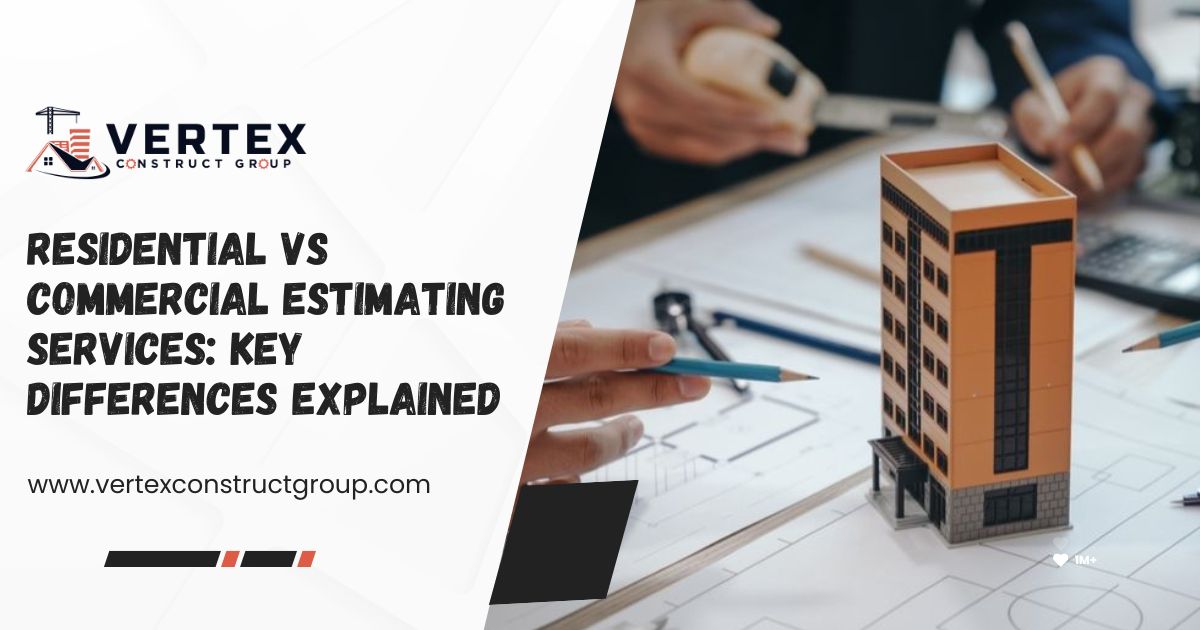
Residential vs Commercial Estimating Services: Key Differences Explained
If you’re looking to start off a construction project on the right foot, then having an accurate estimate is paramount. Whether you are a homeowner fixing up your house or a business planning for a large office building, being able to discern between residential and commercial estimating can help guide you in the best decision. Both require careful planning, but they are very different in scale, cost and complexity. In this post we’ll put a comparison of the two, and talk about the advantages and downsides of both.
Scope and Complexity
Residential estimating typically involves smaller projects, like constructing a house or performing a renovation. Typically, such projects are also simpler in that they employ standard materials and conventional construction techniques. For homeowners, they can generally expect a good idea of cost upfront because the job’s well defined, easy to estimate.
“When you want to build a little table, or remodel your kitchen that expertise falls into one bucket,” he said, “versus going to the other end and taking on large projects, like office buildings, malls or factories.” These are tougher because they call for special materials, systems (think heating and air conditioning and plumbing) and because of those darn safety rules. Since commercial projects are typically more complicated, it requires additional time and effort to estimate them.
Cost Variations
Residential projects also are more predictable in terms of cost. Because the job is smaller and uses standard materials, prices shouldn’t fluctuate much from week to week, which means homeowners generally can expect a fixed cost. But there are also unforeseen issues that can still arise, such as problems with the foundation or alterations to design elements, which can have cost implications.
But commercial projects have far more price changes. These projects require specific materials that can be more costly and difficult to source. There are also other variables such as zoning laws and permits that can unexpectedly add to costs. Because commercial projects are larger, the cost can vary widely during construction.
Timeframe and Project Management
Timeframes are typically shorter for residential projects. The project is smaller and can be finished soon. Homeowners want the project to be done in X amount of time, and most often construction runs more efficiently because there are less people involved.
But commercial projects can often last much longer to complete. They’re larger and involve many more stakeholders, including contractors and regulators. There’s also a lot more to keep track of, including material procurement, meeting safety codes and delays. All of these can make the timeline for commercial projects considerably longer.
Materials and Resources
Since materials in residential projects tend to be standardized, they can be readily located and therefore relatively inexpensive. Because this type of project typically lacks special materials, the estimation process is easier and more expedient.
For commercial projects, the materials can be either custom or rare to track down. These can be pricier and slower to ship. Estimators also have to allow for longer delivery times and time for sourcing these specialistic materials, all of which adds complexity to the commercial estimator.
Labor and Expertise
In residential construction, the work is largely general in nature and can be performed by skilled workers, such as carpenters, electricians or plumbers. These laborers are more readily available and can be paid less than those needed to work on commercial projects. This is what keeps the price of home estimating so cheap.
For commercial assignments, the job calls for a much more specialized talent. Perhaps you need engineers, or workers who have specialized training and knowledge of particular systems for example, air conditioning or electrical work. Because the labor is more specialized, it tends to be more expensive generally and requires a bit more coordination to make sure everything happens as it should.
Technology and Software
Residential estimating tends to be based on less sophisticated software or even the number crunching in basic spreadsheets. These resources are designed to perform rapid estimates of costs and project requirements without the use of complex technology. They’re simple to operate and users don’t need much training.
With commercial estimating, by contrast, the software is much more sophisticated. It’s this technology that enables the tracking of bigger spends, schedules and coordinating stop teams. Such requirements are inevitable while managing a commercial level project and the tools to get a job done need a certain level of experienced people.
Accuracy and Detail
Both types of estimating require precision, but there is simply less room for error on commercial projects. Because commercial projects are larger and more complicated, the smallest error in estimating can spiral into big cost overruns or a delayed open. The process of estimating for a commercial project should be very accurate in order to prevent issues later on.
Residential jobs require accuracy as well, but since they are smaller mistakes may not carry as substantial a cost. But, homeowners should remember that there can be hidden problems and extra costs before the work is completed.
Risk Management
For houses, risk mitigation is quite straightforward. “What you could consider are the main risks would be weather delays, minor tweaks to design or this small element and that small thing while under construction,” she said. These are typically manageable, just not easily.
In commercial projects, the potential gambles are larger, and more multifaceted. These projects encounter problems such as compliance changes, unanticipated costs and the difficulties around communication across multiple teams. Developers in commercials rely on project estimators to carefully plan for these risks and assure they don’t turn into big problems down the road.
The Pros and Cons of Residential Estimating Services
Pros of Residential Estimates
- Predictable Costs: Residential jobs are also easier to estimate since there are less variables. Homeowners can generally count on clear pricing going in.
- Faster Schedules: Residential projects tend to have a shorter schedule, so the project will be completed more quickly.
- It's simple: There are less moving pieces when it comes to residential estimating, so there is a lower likelihood of making mistakes.
Cons of Residential Estimates
- Minimal Customization: Many residential projects use standard construction materials, and perhaps don’t have the look or feel that some homeowners desire.
- Surprise Costs: While costs might be predictable, surprises can still occur such as structural issues and lead to more expensive repairs.
- Missed opportunities: Smaller residential work can overlook chances to fine tune design or save money.
The Pros and Cons of Commercial Estimating Services
Pros of Commercial Estimates
- Plan For the Whole Project: Commercial quotes include all services needed in order to create a complete and precise budget.
- Customization: Commercial projects generally allow for more custom design and material opportunities to blend with specific needs.
- Risk management: Commercial estimators consider more risks, which leaves them in a better position to deal with any problems that arise throughout the course of the project.
Cons of Commercial Estimates
- Expensive: Commercial builds are complex and more expensive to build due to greater initial costs, pricey materials, and labour.
- Longer timelines: Commercial projects have longer schedules, because they are more complicated and require more coordination.
- Coordination Issues: With so many participants, the project administration can become complex and delays or misunderstandings may occur.
Conclusion
Homeowners and businesses need to know that residential and commercial estimating services have marked differences, and knowing the differences can help an owner make smarter choices. Residential are small, easy and standardized Commercial are bigger, complicated, and get more detail oriented. By weighing the key pros and cons of each, you’ll be able to plan your project accordingly, stay on budget, and remain on schedule. Whether you are constructing a home or business, using the right estimating service is a necessity to getting your project completed.

All Categories
Recent Posts

Top Benefits of Hiring Professional Estimating Services in the USA

Why Accurate Material Takeoffs Matter in Construction Projects
Residential vs Commercial Estimating Services: Key Differences Explained
Tags
MON-SAT 8:00-9:00
+91 69 863 6420